Energy Crunch

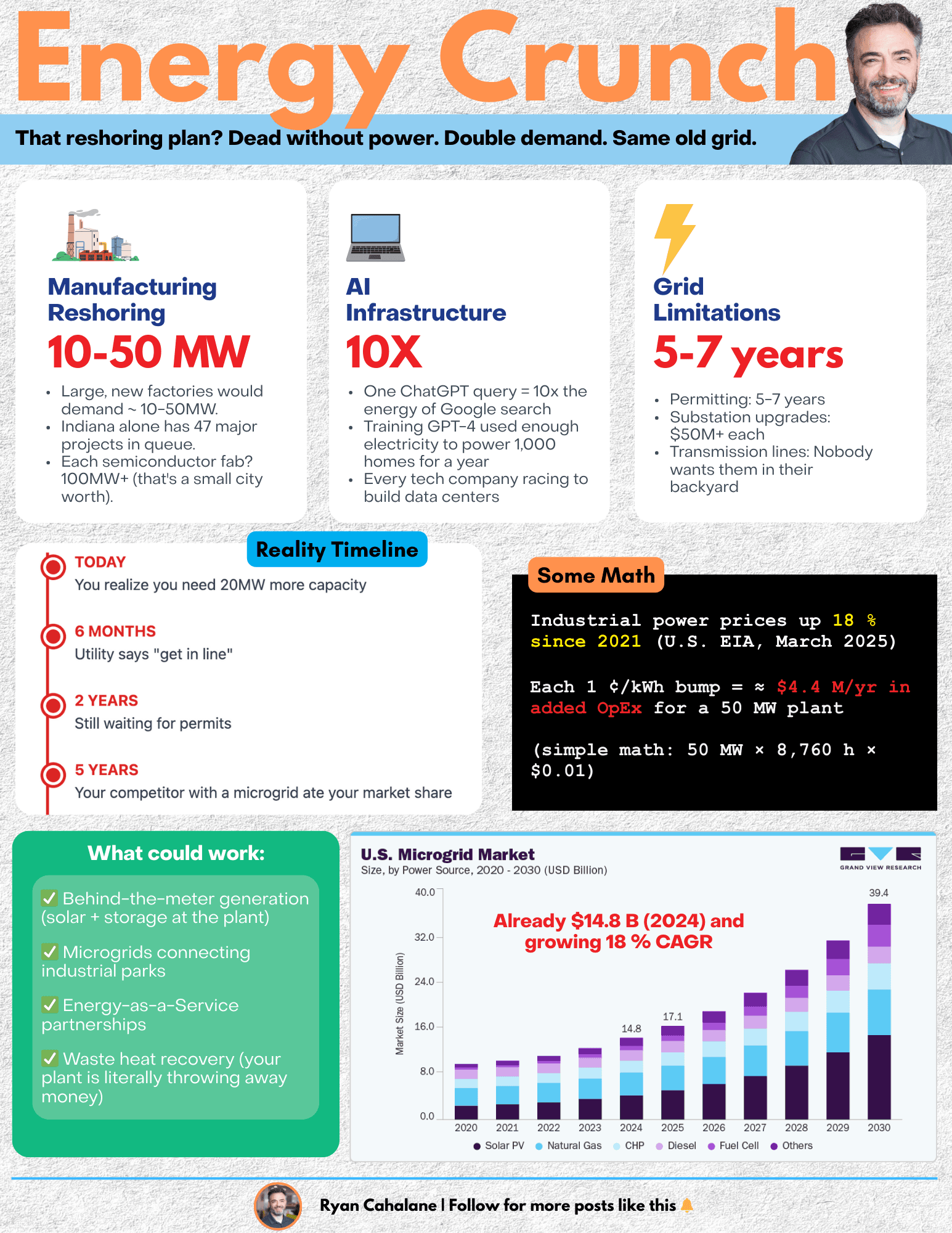
Everyone's excited about reshoring. Politicians love it. Economists model it. LinkedIn consultants won't shut up about it.
There's just one problem.
The math doesn't work.
Double the Demand, Same Old Grid
We're talking about bringing manufacturing back to the US at scale. Chip fabs. Battery plants. EV production. Heavy industry that left decades ago.
All of it needs power. A lot of power.
And we're planning to run it on a grid that was designed when Carter was president.
In Indiana alone—a state that's actually doing something about this—normal energy growth is maybe 0.5-1% annually. To support AI and data center buildout, they need to double capacity in 3-5 years. Just for the data centers.
Now add reshoring on top of that.
The permitting takes years. The infrastructure takes longer. And we're acting like this is just going to... happen.
The Emperor Has No Power Lines
Here's what nobody wants to talk about: reshoring isn't limited by tariffs or labor costs or supply chains anymore.
It's limited by whether you can keep the lights on.
You can have the best manufacturing plan in the world. Billions in investment. Government incentives. Perfect site selection.
None of it matters if you can't plug it in.
I've been working with manufacturers through Indiana's Energy INsights program—which is, by the way, the best smart manufacturing and energy program I've seen in the country. We help companies understand their energy usage, put tools in place to manage costs, and use that as a path into Industry 4.0.
And even in a state that's ahead of the curve, the infrastructure conversation is constant. Because everyone's doing the math. And the math is terrifying.
What This Actually Means
So what happens?
Three scenarios:
1. We build the grid infrastructure to support reshoring This means massive investment, streamlined permitting, and timeline compression. Indiana is proving it can be done. But can we scale that nationally? Before the political winds shift?
2. We don't build the infrastructure, and reshoring stalls The factories that do come back cluster in the few places that can actually power them. Everyone else gets left behind. Regional inequality gets worse. Manufacturing returns, but not evenly.
3. We build without the infrastructure, and brownouts become the new normal This is the worst option. Unreliable power. Production disruptions. Manufacturers who reshored realizing they can't run at capacity because the grid can't handle it.
Pick your disaster.
The Opportunity Nobody's Talking About
Here's the thing: this doesn't have to be a crisis.
It could be the catalyst that finally forces us to modernize energy infrastructure. To think seriously about distributed generation. To make energy efficiency and smart manufacturing not just nice-to-haves, but requirements.
Companies that get ahead of this—that invest in understanding their energy usage, that build flexibility into their operations, that can produce when power is available and store when it's not—they're going to have a massive advantage.
The ones waiting for someone else to solve the grid problem? They're going to be stuck.
What You Can Do
If you're a manufacturer, especially small or mid-market:
Start with energy visibility. You can't manage what you don't measure.
Look at programs like Indiana's Energy INsights. Other states should be copying this model. (And if you're in Indiana, DM me—seriously, it's 100% funded with a one-page application.)
Think about on-site generation. Solar. Natural gas. Storage. The cost has dropped dramatically. Grid independence isn't just for preppers anymore.
Build energy flexibility into your operations. Can you shift high-demand processes to off-peak hours? Can you ramp down when prices spike? The manufacturers who can adapt to dynamic energy availability will outcompete the ones who can't.
The Bottom Line
Reshoring is happening. It has to happen.
But it's not happening on the timeline everyone thinks. And it's not happening everywhere.
The limiting factor isn't going to be trade policy or labor markets.
It's going to be whether we can keep the damn lights on.
Indiana gets it. They're building for it.
The rest of the country needs to wake up.
Because that reshoring plan you're celebrating? It's running on fumes and hope right now.
Time to plug in the reality.